
ODM Jewelry Development When You Only Have a Sketch
A pencil drawing is a working input, not a delay. The published ODM route takes sketches, reference images and written ideas and turns them into a dimensioned CAD drawing and renderings inside 48 hours, then into a physical master sample in 25–30 days. What you need before the first message is not a drawing — it is a decision on base material, because that single choice sets the minimum at 50, 100 or 100+ pieces per design.
Key takeaways
- Rough sketches, reference photographs and written concepts are all accepted as ODM inputs.
- Sketches become dimensioned drawings and renderings inside 48 hours for approval.
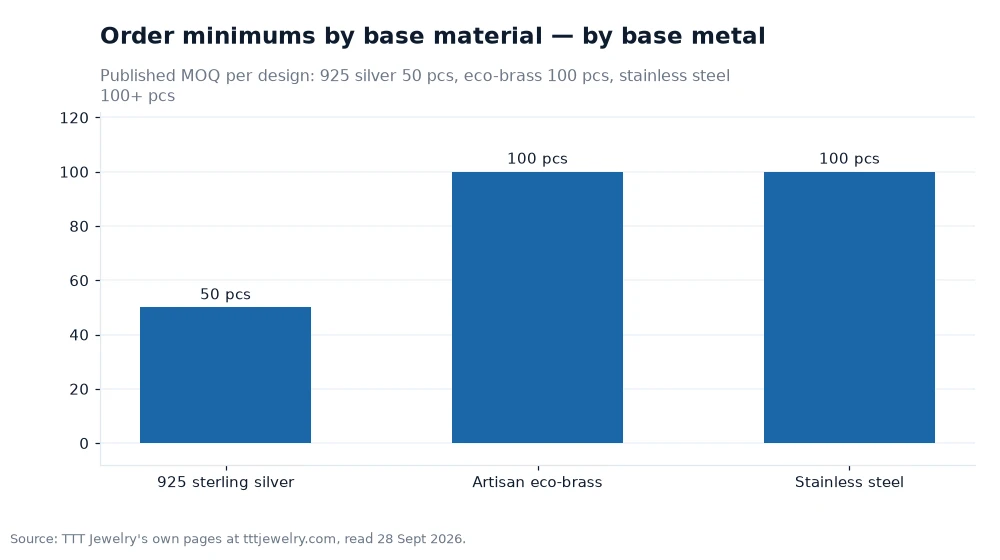
- Order floors are 100+ pieces in stainless steel, 50 pcs in the silver line and 100 pcs in artisan brass, per design.
- Sampling takes 25–30 days across five operations before production begins.
A sketch is a legitimate starting point
Sending a rough idea feels like arriving unprepared, but the consultation stage exists precisely for that. The design team works through feasibility, material selection and cost structure with you before any drawing is made, which means an unfinished concept is the expected input rather than a problem to solve first.
What makes a sketch useful is not its quality but its specificity. A ring drawn from the front with no band width, or a pendant with an unclear bail, will generate questions; the same shapes with two or three dimensions written beside them move into drawing immediately.
What the design team adds to your sketch
Four things usually get resolved in that first pass. Proportions are normalised so the piece reads at retail size. The stone layout is set, using natural stones or freshwater pearls if the sketch suggests accents. The construction is chosen — cast or assembled, and how the chain or finding attaches. And the surface treatment is planned, which is where the plating stack and the polishing route get decided.
You end up with an OEM/ODM brief in reverse: instead of writing a specification for a factory, you approve one the factory drafted.
The three published minimums and what they shape
The metal you name decides the size of your first order, and it also decides the tooling route. Silver casts cleanly at small volumes, so a sketch-led collection can be broad. Brass and stainless steel carry more set-up, so the entry quantity is higher even when the design is identical.
| Base material | Minimum per design | What a sketch-led label should know |
|---|---|---|
| 925 sterling silver | 50 pcs | Lowest entry point for testing several shapes at once |
| Artisan eco-brass | 100 pcs | Plated look, higher first quantity per design |
| Stainless steel | 100+ pcs | Machined route with PVD vacuum plating |
Read that table as a range plan rather than a price list. If a first season has six shapes, the silver route supports it at 50 pieces each, while the same six shapes in eco-brass would start at 100 pieces each.
Where a sketch becomes a drawing, and what that costs
The CAD stage is quoted at under 48 hours and covers a technical drawing plus realistic renderings for dimensional approval. It is the point where your idea stops being negotiable in general terms and starts being negotiable in millimetres, which is why the feedback loop is worth using properly.
Changes here are screen changes. Ask for the band a little wider, the stone a little further from the edge, the bail a little thicker — the drawing comes back. The same requests after casting mean a new wax print and a new mould, which is why the drawing deserves a careful look rather than a quick nod.
Worked example: 50 pieces against 100 on a six-shape season
Take the published minimums and apply them to a small range. Six designs in 925 sterling silver is 6 × 50 = 300 pieces. The same six designs in artisan eco-brass is 6 × 100 = 600 pieces. So the same sketch-led collection is either a 300-piece order or a 600-piece order, purely on the metal decision, before a single stone is added.
The ratio is simple: 50 ÷ 100 = 0.5, so the silver minimum is half the brass minimum per design. The multiplication is mine; the 50 and 100 piece figures are published.
The five operations between drawing and sample
Once the drawing is approved, the sample window of 25–30 days opens. Inside it the piece passes through the 3D wax print first, then precision mould casting, stone-setting, bench polishing and custom plating — which is where the finish options arrive: 14K, 18K or 24K gold, or rhodium, with an anti-tarnish e-coating applied over silver and brass.
If your sketch has no stones at all, one operation gets lighter but does not disappear, because casting and plating still carry the same sequence. A stone-free design is cheaper to sample, not faster by a month.
Getting a usable quote from an unfinished idea
Three sentences in the first message do most of the work: what the piece is, what metal it should be, and roughly how many you plan to sell in the first run. Everything else — plating choice, packaging, hallmark placement — can be decided during the consultation without delaying the drawing.
Then hold the answers still for two days. The published CAD turnaround assumes a brief that does not change while it is being drawn, and an idea that shifts mid-drawing is the one thing a sketch-led project cannot absorb quickly. What a sketch-based brief still has to carry is listed by the OEM ODM jewelry manufacturer, and the brass range The standard questions cover the rest of the brief. works the same idea through a single alloy.
Frequently asked questions
Can an idea with no drawing at all be sampled?
Yes. If the concept is still a cake drawn to scale, describe it in words with two or three measurements; the design team drafts the drawing and you approve it before tooling.
How many revisions does the sketch process allow?
Feedback during consultation and the 3D CAD stage is part of the 48-hour review loop. Requests made after casting are new tooling work rather than revisions.
Is a sketch-led order priced differently?
The route is the same one an OEM/ODM supplier quotes for a fully specified brief: one design, one minimum, 25–30 days of sampling and 3–4 weeks of production.
From first pencil line to first carton
The path is shorter than people expect: two days of drawing, a month of sampling, and three to four weeks of production once the sample is approved. What stretches it is not the absence of a design file, it is a metal choice made late or changed midway.
Labels that develop a whole family at once get more out of this route than labels that develop one piece at a time, because the consultation covers chains, stones, hallmarks and packaging in a single pass. If the plan is a plated collection rather than a precious metal one, read how the brass jewelry range is finished before fixing the brief, and check the standard questions buyers ask before the first call.
Tracked back — the 100% NDA terms plus the master sample rule and the S925, 316L and 18KGP mark set — every one of them came from the manufacturer's own site at tttjewelry.com itself, as of 28 Sept 2026. The site also names ISO 9001:2015 for quality management. The arithmetic in the worked example is mine — the site supplies the inputs only [1]