
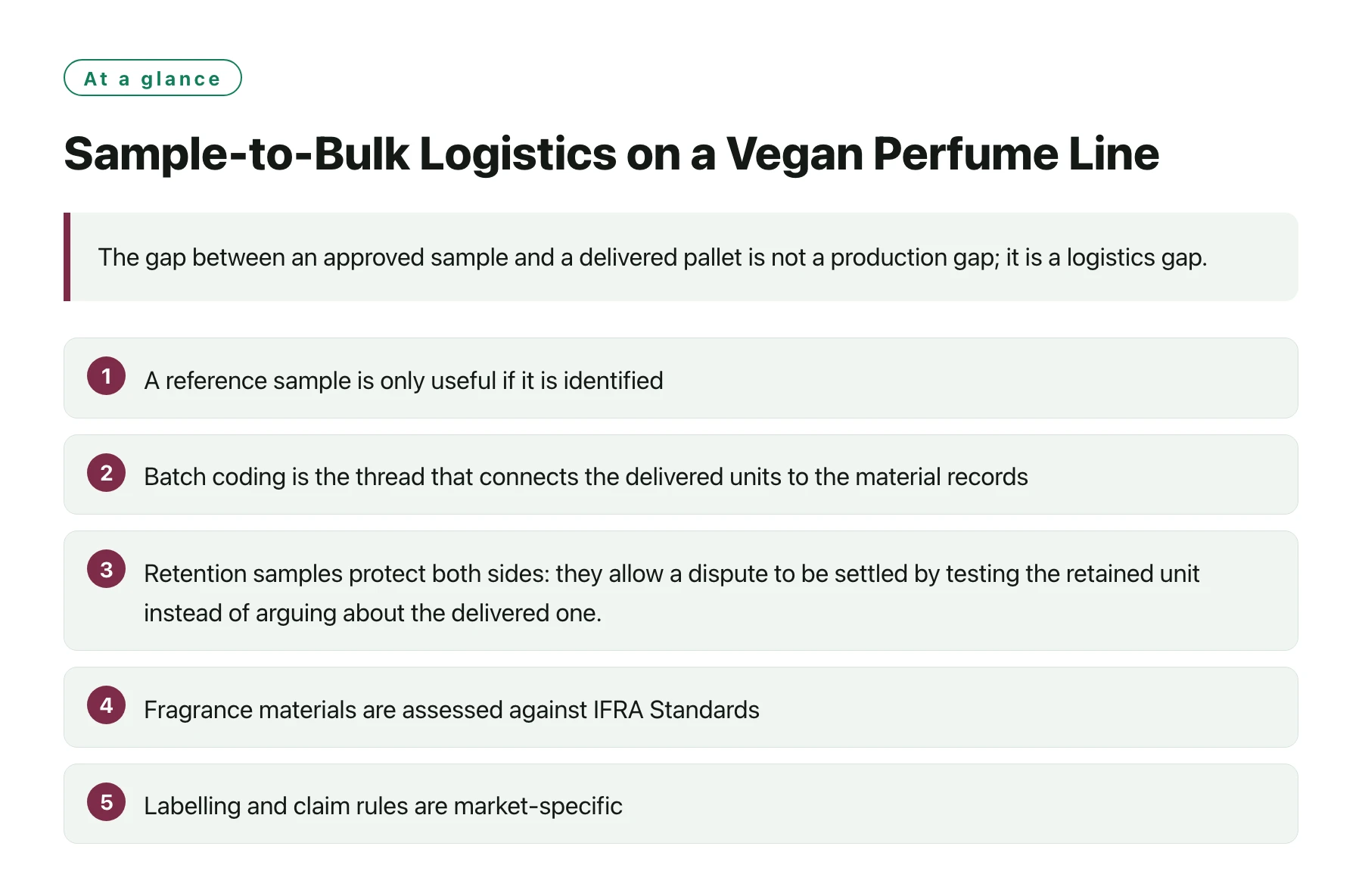
The gap between an approved sample and a delivered pallet is not a production gap; it is a logistics gap. Between those two points the project passes through material ordering, compounding, filling, packing, testing and freight, and each handover is a chance for the delivered goods to differ from what was signed off. On a vegan line there is an extra reason to care, because a substitution made quietly during production can invalidate the ingredient position the brand has been selling.
Key takeaways
- A reference sample is only useful if it is identified, stored and traceable; an unlabelled bottle on a shelf is a memory rather than a control.
- Batch coding is the thread that connects the delivered units to the material records, the compounding log and the test results, so the coding scheme should be agreed before filling rather than after.
- Retention samples protect both sides: they allow a dispute to be settled by testing the retained unit instead of arguing about the delivered one.
- Fragrance materials are assessed against IFRA Standards, and substituting a material after approval changes that assessment, which is why any substitution needs a written decision and a new reference [1].
- Labelling and claim rules are market-specific, and the European Commission's cosmetics pages are a useful reference for how product-specific topics are handled in one major market [2].
Most brands manage the sample stage carefully and then relax once the sample is approved. The result is a handover that depends on memory: someone remembers the dosage, someone else remembers the bottle weight, and the vegan exclusion list stays in an email thread.
This article treats the sample-to-bulk handover as a logistics problem with named control points. It is written for a procurement or operations lead who has to make the delivered order match the approved one, three months after the sample was signed.
Start with the reference sample, not with the purchase order
The approved sample is the specification in physical form. Everything that follows is an attempt to reproduce it at scale. That makes the sample's identity a control point in its own right: which batch it came from, who approved it, when it was approved, and where the retained unit is kept.
A practical minimum is a signed approval sheet that names the sample code, the person approving, the date, and the exact description of what was approved, including the fill size and the pack components. Where the brand has a vegan specification, the approval sheet should reference the exclusion list version that applied at that moment.
This matters because almost every later dispute traces back to an ambiguity at approval. If two people approved slightly different samples, or if the approved sample was a hand-filled unit rather than a production-intent batch, the difference will reappear in the delivered pallet.
The five records that carry an order from sample to pallet
| Record | Who issues it | When it must exist |
|---|---|---|
| Approved reference sample sheet | Brand and supplier, countersigned | Before bulk production is scheduled |
| Material declaration and batch numbers | Supplier, per delivered material lot | Before compounding starts, so any substitution is visible early |
| Compounding and filling log | Supplier, at the line | During production, not reconstructed afterwards |
| Certificate of analysis and test summary | Supplier or third-party laboratory | Before release, as the basis for shipping approval |
| Retention sample record | Supplier, with brand acknowledgement | At the same time as the delivered units are packed |
Each record has a natural deadline, and every deadline sits before the stage it protects. A record produced after the pallet has shipped cannot prevent a problem; it can only document one.
Chain of custody during production
An OEM perfume manufacturer in China typically runs several orders through the same line in a week, which is exactly why batch coding matters. If the coding scheme is agreed late, the delivered units may carry a code that connects them to a shipment rather than to a production batch, and the connection to the material records is lost.
Ask how the factory links the code on the unit to the compounding log. A workable answer names the compounding date, the material lots used and the filling line, and it survives a reorder because the scheme is stable over time. A weaker answer describes a code that only identifies the order.
Quantity reconciliation belongs in the same conversation. Between compounding, filling and packing there are predictable losses, and a first buyer often mistakes normal loss for a shortfall. Agreeing an expected range in advance turns that conversation into a routine check rather than a dispute at delivery.
Vegan-specific substitution control fits here as well. If a material has to be swapped during production, the swap should trigger a written notification with the reason, the substitute and the effect on the finished scent. The brand then decides whether to accept, re-test or hold the order. Allowing that decision to be made silently at the line is the single easiest way for a vegan claim to become inaccurate.
Shipping, samples and the last handover
Between the factory gate and the warehouse, the goods pass through a freight agent, a customs process and a storage period. Nothing in that chain improves the product, and several parts can damage it. Fragrance products usually tolerate normal ambient conditions, but heat exposure during a long transit is worth planning for, particularly for formats with a high alcohol content or a soft pack.
Samples travel separately and often arrive before the bulk, which is why they deserve their own control. A brand that receives a bulk sample but cannot match it to the approved reference is relying on memory. Sending the reference sample with the same courier route, or at least recording the test conditions, makes the comparison meaningful.
The final document set is the last handover and the one most likely to be incomplete. It should be assembled while the goods are in production, not after they ship. Brands that list the required documents before the order is placed tend to receive a complete set, because the factory knows what will be checked.
It also helps to understand the whole sequence rather than just your own stage. Seeing how a project moves from formula to finished bottle makes it obvious where a document request can be inserted without stalling production, and where it cannot.
Why a bulk order can differ from the sample, and what to do about it
There are legitimate reasons for small differences between a sample and a bulk run. Compounding at scale behaves differently from bench work, maceration takes longer, and filling equipment introduces its own tolerances. These effects do not have to be a problem if the acceptance criteria are agreed in advance.
There are also illegitimate reasons, and they are usually traceable to a substituted material or an unrecorded process change. This is where the document chain earns its place: with material batches and a compounding log, a difference can be investigated rather than argued about.
The practical control is a comparison protocol. When bulk arrives, evaluate it against the retained reference under the same conditions, on skin and on paper. Where a difference is found, check the material records first, because the answer is usually there. Understanding why a sample and the bulk order can differ in advance keeps a small variation from being treated as a crisis.
Brands that keep compounding, filling and packing within one managed sequence usually find this simpler, because the records sit with one team. It is one reason a fragrance manufacturing under one roof structure is easier to audit than a chain of separate suppliers, although it still depends on the records actually being kept.
Write the handover as a list of records with deadlines, then check that each deadline falls before the stage it protects. If a record is due after shipping, either move the deadline or accept that the control does not exist.
Sources
- IFRA Standards Library (International Fragrance Association) —— The IFRA Standards Library lists the restrictions the fragrance industry applies to individual fragrance ingredients, based on safety assessments; it is the reference point for compliant fragrance formulation.
- European Commission: Cosmetic Products — Specific Topics —— EU pages covering specific cosmetics topics such as product claims, nanomaterials and animal-testing rules.
Frequently asked questions
How many retention samples should be kept?
Enough to allow one to be tested and one to be kept. Most brands agree that the supplier retains units from each production batch and that the brand keeps a smaller set from the delivered pallet, so both sides can test without consuming the only remaining reference.
How long should retention samples be kept?
At least as long as the product's shelf life, plus a margin for any dispute that surfaces near expiry. The relevant period depends on the format and the market, so it is better agreed in the order terms than assumed.
What should happen if the factory substitutes a material after approval?
It should trigger a written notification with the reason, the substitute and the expected effect on the scent, followed by a brand decision to accept, re-evaluate or hold. Any fragrance material change also affects the assessment against IFRA Standards, so the documentation has to be updated.
Who owns the reference sample?
Both parties usually hold one. The brand needs its copy to compare against delivered goods, and the supplier needs one to run the line against. Ownership of the physical unit matters less than having the same identified sample on both sides.
Can a brand inspect production before the pallet ships?
Often yes, and it is worth requesting early rather than assuming. A short inspection during filling or packing is usually more useful than a final check after everything is boxed, because issues found on the line can still be corrected in that run.
How should a brand handle normal production loss?
Agree an expected range before the order starts and treat the range as part of the commercial terms. Fragrance products lose material at compounding, filling and packing, and a small deviation inside an agreed range is normal rather than a sign of a problem.